Rev. Joseph Boyd Lyons, pastor (BBC Sta. Mesa) and president of Asia Baptist Bible College (a church ministry)
 Dr. Mickey P. Carter, Landmark Baptist College, Haines City, Florida, USA


 Rev. Joseph Boyd Lyons, pastor (BBC Sta. Mesa) and president of Asia Baptist Bible College (a church ministry)Dr. Mickey P. Carter, Landmark Baptist College, Haines City, Florida, USA
1. Dare any of you, having a matter against another, go to law before the unjust, and not before the saints?I welcome your ideas as to how we can mediate and conciliate church splits. Incidentally, under the Securities Regulation Code, church splits would fall under “intra-corporate controversies” and are under the jurisdiction of the Regional Trial Court.
2. Do ye not know that the saints shall judge the world? and if the world shall be judged by you, are ye unworthy to judge the smallest matters?
3. Know ye not that we shall judge angels? how much more things that pertain to this life?
4. If then ye have judgments of things pertaining to this life, set them to judge who are least esteemed in the church.
5. I speak to your shame. Is it so, that there is not a wise man among you? no, not one that shall be able to judge between his brethren?
6. But brother goeth to law with brother, and that before the unbelievers.
7. Now therefore there is utterly a fault among you, because ye go to law one with another. Why do ye not rather take wrong? why do ye not rather suffer yourselves to be defrauded?
8. Nay, ye do wrong, and defraud, and that your brethren.
1. Let every soul be subject unto the higher powers. For there is no power but of God: the powers that be are ordained of God.
2. Whosoever therefore resisteth the power, resisteth the ordinance of God: and they that resist shall receive to themselves damnation.
3. For rulers are not a terror to good works, but to the evil. Wilt thou then not be afraid of the power? do that which is good, and thou shalt have praise of the same:
4. For he is the minister of God to thee for good. But if thou do that which is evil, be afraid; for he beareth not the sword in vain: for he is the minister of God, a revenger to execute wrath upon him that doeth evil.
5. Wherefore ye must needs be subject, not only for wrath, but also for conscience sake.
The question is, Why did the church continue with the imposition of discipline when Guinn had already withdrawn her membership from the church? Well, the church did not have a provision in its Constitution for a member withdrawing membership. The church also did not have a tradition of a member withdrawing her membership; in cases of discipline, it was the church which withdrew fellowship with the erring church member.
Below are the facts of the case as taken from the decision of the Oklahoma State Supreme Court. I will discuss later on the ramifications of the said decision.
MARIAN GUINN, PLAINTIFF-APPELLEE,v. THE CHURCH OF CHRIST OF COLLINSVILLE, OKLAHOMA, A NON-PROFIT CORPORATION; ALLEN CASH, TED MOODY AND RON WITTEN, DEFENDANTS-APPELLANTS.The Marian Guinn Case [2]: the right of church discipline ends upon withdrawal of membership
On appeal from the District Court, 0 In an action for damages from invasion of privacy and intentional infliction of emotional distress, brought by a former parishioner against the congregation and its leadership, judgment was rendered on a jury verdict for the plaintiff. On appeal by the defendants, JUDGMENT IS REVERSED AND CAUSE REMANDED.
[775 P.2d 767]
1 The dispositive first-impression question presented is whether a state forensic inquiry into an alleged tortious act by a religious body against its former member is an unconstitutional usurpation of the church's prerogatives by a secular court and hence prohibited by the First Amendment. We answer in the negative.
I FACTS
2 The plaintiff-appellee, Marian Guinn [Parishioner], and her children moved to Collinsville, Oklahoma in 1974. While staying with her sister, Parishioner became acquainted with the defendants-appellants, Ron Whitten, Ted Moody and Allen Cash [collectively referred to as the "Elders"] in their capacities as Elders of the Collinsville Church of Christ. A few weeks later, Parishioner became a member of that congregation. Both Parishioner and the Elders agree that the first few years of Parishioner's membership reflected the mutual support inherent in a relationship between a religious organization and one of its members. Parishioner attended services and the congregation extended to her a financial and emotional helping hand.
3 In 1980 the Elders confronted Parishioner with a rumor that she was having sexual relations with a male Collinsville resident [companion], who was not a member of the Church of Christ. According to the Elders, they pursued this rumor in order to uphold their doctrinal commands which require that they, as church leaders, monitor the congregation members' actions, as well as confront and discuss [775 P.2d 768] problems with any one who is "having trouble." The Church of Christ follows a literal interpretation of the Bible which serves as the church's sole source of moral, religious and ethical guidance. When confronted with the allegation, Parishioner admitted violating the Church of Christ's prohibition against fornication. As a transgressor of the denomination's code of ethics, Parishioner became subject to the disciplinary procedure set forth in Matthew 18:13-17.1
4 The Elders carried out the biblically-mandated disciplinary procedure in three stages, with the entire process lasting more than a year. First, the Elders approached Parishioner and her children in a laundromat and requested that she appear before the church and repent of the fornication sin. They also suggested that Parishioner refrain from seeing her companion.
5 The second of the three "meetings" was held at the church. According to the Parishioner, her attendance dropped considerably after the Elders initially confronted her in the laundromat. The Elders had called Parishioner and told her that if she did not come to church to discuss her continuing relationship with her companion they would come to her house. Although the bad weather that night made the Parishioner anxious about leaving her children alone, she decided to meet with the Elders at the church. They instructed her to stop seeing her companion. Parishioner agreed this was the best solution because her relationship with him was deteriorating.
6 The third and final meeting took place on the driveway outside the Parishioner's home when she was under suspicion of having been with her companion. The Elders parked near Parishioner's house and awaited her arrival. When Parishioner's car pulled into the driveway, the Elders approached it and told Parishioner and her companion that if she did not appear before the congregation and repent of her fornication sin, the members would "withdraw fellowship"2 from her.
7 On September 21, 1981, a few days after the third meeting, the Elders sent Parishioner a letter warning her that if she did not repent, the withdrawal of fellowship process would be commenced. At this point Parishioner realized the Elders intended to inform the congregation of her sexual involvement with the companion. She sought legal advice in an effort to ascertain her rights. On September 24 her lawyer sent the Elders a letter and advised them not to expose Parishioner's private life to the Collinsville congregation which comprised approximately five percent of the town's population. The Elders did not heed her lawyer's advice.
8 On September 25, 1981 Parishioner wrote the Elders a letter imploring them not to mention her name in church except to tell the congregation that she had withdrawn from membership. The Elders ignored Parishioner's requests. On September 27 [775 P.2d 769] they read to the congregation the September 21 letter they had sent to Parishioner. During the same service the Elders advised the congregation to contact Parishioner and to encourage her to repent and return to the Church. The Elders also told the congregation that should their attempts fail, the scriptures Parishioner had violated would be read aloud at the next service and the withdrawal of fellowship proceeding would begin.
9 Parishioner met with one of the Elders personally and again attempted to dissuade him from divulging her private life to the congregation. The Elder told her that withdrawing membership from the Church of Christ was not only doctrinally impossible but it could not halt the disciplinary sanction being carried out against her. The Church of Christ believes that all its members are a family; one can be born into a family but can never truly withdraw from it. A Church of Christ member can voluntarily join the church's flock but cannot then disassociate oneself from it.
10 According to one of the Elders, Parishioner was publicly branded a fornicator when the scriptures she had violated were recited to the Collinsville Church of Christ congregation on October 4. As part of the disciplinary process the same information about Parishioner's transgressions was sent to four other area Church of Christ congregations to be read aloud during services.
11 For the torts of outrage and invasion of privacy Parishioner recovered actual and punitive damages from the three Elders and from the Collinsville Church of Christ.3 Parishioner alleged in her claim of outrage that when disciplining her the Elders employed methods which caused her emotional anguish. Her claim of invasion of privacy was cast in two theories. Firstly, Parishioner asserted the Elders intruded upon her seclusion by carrying out against her religious disciplinary measures which were highly offensive, unreasonable and intrusive. Secondly, Parishioner claimed the Elders unreasonably publicized private facts about her life by communicating her transgressions to the Collinsville and the four other area Church of Christ congregations. After overruling the Elders' demurrers and their motion for summary judgment, the trial court submitted the case to the jury; its verdict was in favor of Parishioner and against each of the three individual Elders. The parties stipulated the Elders were at all times acting as agents of the Church of Christ corporation and thus the trial court found the judgment against the Elders also was a judgment against the Collinsville Church of Christ. The jury awarded $205,000 in actual and $185,000 in punitive damages; the trial court then added $44,737 in prejudgment interest.
“At the option expressed in writing by the parents or guardians, and without cost to them and the government, religion shall be taught to their children or wards in public elementary and high schools as may be provided by law.”In keeping with this Constitutional mandate, the Department of Education has issued several orders on the mechanics of the teaching of religion in public elementary and high schools. These are DepEd Order No. 26, s. 2002 and DECS Order No. 120. s. 1999 amending certain provisions of DECS Order No. 13, s. 1999. (Special thanks to Bro. George Meris of Christ Baptist Church, Soldiers Hill, Muntinlupa for bringing these DepEd regulations to my attention.)
US Supreme Court rulings on freedom of religion1. Declaration of Policy – The State shall, in conformity with the mandate of the Constitution, encourage and promote the teaching of religion to children in public elementary and high schools within the regular class hours. The State is cognizant of the vital role that the teaching of religion assumes in citizen formation, particularly the modeling of our youth. Hence, the State recognizes the necessity of religious instruction not only in the private schools but also in public schools. For these purposes, the Department hereby provides the mechanics to enable the teaching of religion in all public elementary and high schools in the country, fully aware that the Constitution prohibits the government from favoring a particular establishment or religion or prohibiting the free exercise thereof. Furthermore, the implementation of this Order should not entail additional cost to the government.
2. Coverage – This Order shall apply to all public elementary and high schools in the Philippines.
3. Definition of terms – As used in this Order, the following terms shall mean:
a. Religion – an institutionalized system of beliefs, attitudes and practices.b. Values Education – the integration into the school curriculum of universally accepted as well as Filipino human, social, moral, political, economic and cultural values.
c. Optional Religious Instruction – refers to the religion classes conducted in the public elementary and high schools for students or pupils whose parents opted to exercise their rights to request religious instruction in public schools for their children or wards. The optional character of religious instruction in public schools is a prerogative or choice of the parents or guardians, who are free to request or not to request that the children under their care be instructed in the religion of their choice.
d. Regular class hours – refers to the regular or normal scheduled periods of instruction or laboratory work for a student.e. Class period – the average length of time scheduled for one session or instructional period in a course.
4. The Teachers/Instructors – The religious teachers/instructors who teach religion classes in the public elementary and high schools shall be formally sourced or recruited by the respective principal or school heads in accordance with the corresponding request for optional religious instruction. After their designation or nomination by their respective religious authorities, said teachers/instructors shall submit to the principal or school head their proper authorization papers and request for time allocation and schedule for the optional religious instruction. Ordinary teachers teaching in a particular school may also teach their religion in the same or another school during the periods when they are free from their ordinary teaching loads, and provided they are authorized to do so by the competent religious authority of their denomination.
5. Recipient of Religious Instruction – The teachers/instructors of religion as referred to in Paragraph 4 shall be allowed to teach those pupils/students whose parents or guardians have opted to request that their children or wards be taught the religion of their choice. The option to request that their children or wards learn religion in school shall be expressed in writing by the parent or guardian who shall likewise accomplish in full the necessary application form. No student/pupil shall be allowed to attend religious instruction classes without the said written application and duly accomplished request of his/her parent or guardian.
6. The Application – The application referred to in the preceding paragraph shall clearly indicate the faith or religious instruction the student/pupil should receiver from the authorized religion teachers/instructors, and the preferred schedule for religious instruction.7. Non-recipient of Religious Instruction – Students not receiving religious instruction or those with request but without available teacher/instructors for the particular denomination requested should be under the supervision of their respective class advisers during the time religion classes are going on.
8. Size and Scheduling of Religious Classes – The optional religious instruction shall be taught during regular class hours only and not before and after class time, nor during recess time. Religious classes should not number more than forty students of the same level and of the same religion, except where the religious authority certifies that his teacher/instructor can allow for a bigger number due to its practicality, availability of time slot/schedule, instructors/teachers, classroom materials and related matters.
The principal or school head shall fix the schedule of the religion class hours taking into account the number of the religion teachers/instructors that can be fielded by the different denominations at one time.
9. Duration of Religion Classes – The optional instruction shall be allotted at least ninety minutes a week, spread over at least two (2) but not more than three (3) meetings in one week. In no case shall the class periods be allotted less than ninety (90) minutes per week.
10. Optional Religious Instruction and Values Education – The optional religious instruction and values education of this Department are separate, different and distinct subjects. As such, religious instruction shall be allotted separate class hours. Available time slot for religious instruction should be arranged with the principal.
11. Administrative Sanctions – Any principal, school head or teacher who violates any provision of this Order shall, after due process, be subjected to appropriate disciplinary sanctions.
 Four years ago, during a Mandatory Continuing Legal Education seminar, I met a former student from high school. She had attended several of the Mini Press Conferences I organized from 1984 up to 1991 for Rizal High School in Pasig and ten other public and private high schools from Metro Manila. We immediately recognized each other and had a good time remembering the good old days of the Mini Press Con.
(1) Her maiden first name and surname and add her husband’s surname, orPlease take note that under the Family Code provisions on legal separation, a woman is still obligated to use her husband’s surname since the marriage bonds are not severed. It is only in cases of annulment of a voidable marriage or declaration of nullity of a void marriage that a woman can regain the use of her maiden surname.
(2) Her maiden first name and her husband’s surname, or
(3) Her husband’s full name, but prefixing a word indicating that she is his wife, such as Mrs.”
The Constitutional right to equal treatment of both men and women is one which the State endeavors to uphold. Pursuant to this, efforts have been exerted to eliminate vestiges of inequalities found in existing laws.I’m sure a lot of women are nodding their heads enthusiastically and expressing 110% agreement with Sen. Santiago’s bill. If you ask me however, I will not marry a woman who will refuse to carry my surname.
In Republic Act No. 386, also known as the Civil Code of the Philippines and Executive Order 209, also known as the Family Code of the Philippines, a married woman continues to be treated as a mere appendage of her husband. She is not specifically granted the option to use her maiden name and surname.
The principle of fundamental equality between men and women requires the passage of a bill of this nature. By allowing Filipino women to retain their surnames as part of their individuality, even after marriage or legal separation, we shall be eliminating yet another vestige of inequality found in our laws, and translating the constitutional edict into a tangible reality.
The Biblical view on a wife’s use of her husband’s surnameThe husband who gives his name to his bride in marriage is thus not just keeping his own; he is owning up to what it means to have been given a family and a family name by his own father - he is living out his destiny to be a father by saying yes to it in advance. And the wife does not so much surrender her name as she accepts the gift of his, given and received as a pledge of (among other things) loyal and responsible fatherhood for her children. A woman who refuses this gift is, whether she knows it or not, tacitly refusing the promised devotion or, worse, expressing her suspicions about her groom’s trustworthiness as a husband and prospective father.
Patrilineal surnames are, in truth, less a sign of paternal prerogative than of paternal duty and professed commitment, reinforced psychologically by gratifying the father’s vanity in the perpetuation of his name and by offering this nominal incentive to do his duty both to mother and child. Such human speech and naming enables the father explicitly to choose to become the parent-by-choice that he, more than the mother, must necessarily be.
Fathers who will not own up to their paternity, who will not “legitimize” their offspring, and who will not name themselves responsible for child-rearing by giving their children their name are, paradoxically, not real fathers at all, and their wives and especially their children suffer. The former stigmatization of bastardy was, in fact, meant to protect women and children from such irresponsible behavior of self-indulgent men (behavior probably naturally rooted in mammalian male psychosexual tendencies), men who would take their sexual pleasures and walk away from their consequences. The removal of the stigma, prompted by a humane concern not to penalize innocent children by calling them “illegitimate,” has, paradoxically but absolutely predictably, contributed mightily to an increase in such fatherless children.
The advantage a woman and her children gain from the commitment of the man to take responsibility and to stay the course - the commitment implied in his embracing the woman and her prospective children with his family name, now newly understood - is by itself sufficient reason why it is in a woman’s interest as a married-woman-and-mother-to-be to readily take the bridegroom’s name.
But there is a deeper reason why this makes sense. The change of the woman’s name, from family of origin to family of perpetuation, is the perfect emblem for the desired exogamy of human sexuality and generation. The woman in marriage not only expresses her humanity in love (as does the man); she also embraces the meaning of marriage by accepting the meaning of her womanly nature as generative. In shedding the name of her family of origin, she tacitly affirms that children of her womb can be legitimated only exogamously. Her children will not bear the same name as-will not "belong to"-her father; moreover, her new name allows also her father to recognize formally the mature woman his daughter has become. Whereas the man needs convention to make up-by expansion-for his natural deficiency, the woman needs convention to humanize-by restriction-the result of her natural prowess. By anticipating necessity and by thus choosing to accept the gift of her husband’s name, the woman affirms the meaning of her own humanity by saying yes to customizing her given nature.(emphasis by boldfacing supplied)
20. And Adam gave names to all cattle, and to the fowl of the air, and to every beast of the field; but for Adam there was not found an help meet for him.Ephesians 5:21 up to 33 outline the rights and obligations of husbands and wives:
21. And the Lord God caused a deep sleep to fall upon Adam, and he slept: and he took one of his ribs, and closed up the flesh instead thereof;
22. And the rib, which the Lord God had taken from man, made he a woman, and brought her unto the man.
23. And Adam said, This is now bone of my bones, and flesh of my flesh: she shall be called Woman, because she was taken out of Man.
24. Therefore shall a man leave his father and his mother, and shall cleave unto his wife: and they shall be one flesh.
25. And they were both naked, the man and his wife, and were not ashamed.
21. Submitting yourselves one to another in the fear of God.I Peter 3: 1-12 also state the rights and duties of husbands and wives toward each other:
22. Wives, submit yourselves unto your own husbands, as unto the Lord.
23. For the husband is the head of the wife, even as Christ is the head of the church: and he is the saviour of the body.
24. Therefore as the church is subject unto Christ, so let the wives be to their own husbands in every thing.
25. Husbands, love your wives, even as Christ also loved the church, and gave himself for it;
26. That he might sanctify and cleanse it with the washing of water by the word,
27. That he might present it to himself a glorious church, not having spot, or wrinkle, or any such thing; but that it should be holy and without blemish.
28. So ought men to love their wives as their own bodies. He that loveth his wife loveth himself.
29. For no man ever yet hated his own flesh; but nourisheth and cherisheth it, even as the Lord the church:
30. For we are members of his body, of his flesh, and of his bones.
31. For this cause shall a man leave his father and mother, and shall be joined unto his wife, and they two shall be one flesh.
32. This is a great mystery: but I speak concerning Christ and the church.
33. Nevertheless let every one of you in particular so love his wife even as himself; and the wife see that she reverence her husband.
1. Likewise, ye wives, be in subjection to your own husbands; that, if any obey not the word, they also may without the word be won by the conversation of the wives;A wife expresses her Biblical submission by using her husband’s surname
2. While they behold your chaste conversation coupled with fear.
3. Whose adorning let it not be that outward adorning of plaiting the hair, and of wearing of gold, or of putting on of apparel;
4. But let it be the hidden man of the heart, in that which is not corruptible, even the ornament of a meek and quiet spirit, which is in the sight of God of great price.
5. For after this manner in the old time the holy women also, who trusted in God, adorned themselves, being in subjection unto their own husbands:
6. Even as Sara obeyed Abraham, calling him lord: whose daughters ye are, as long as ye do well, and are not afraid with any amazement.
7. Likewise, ye husbands, dwell with them according to knowledge, giving honour unto the wife, as unto the weaker vessel, and as being heirs together of the grace of life; that your prayers be not hindered.
8. Finally, be ye all of one mind, having compassion one of another, love as brethren, be pitiful, be courteous:
9. Not rendering evil for evil, or railing for railing: but contrariwise blessing; knowing that ye are thereunto called, that ye should inherit a blessing.
10. For he that will love life, and see good days, let him refrain his tongue from evil, and his lips that they speak no guile:
11. Let him eschew evil, and do good; let him seek peace, and ensue it.
12. For the eyes of the Lord are over the righteous, and his ears are open unto their prayers: but the face of the Lord is against them that do evil.
[1] “Strike the Original Match” by Chuck Swindoll; Multnomah Press © 1980; specifically the chapters entitled “Let’s Repair the Foundation” and “Bricks that Build a Marriage.”
[2] “The Grace Awakening” also by Chuck Swindoll; Word Publishing, ©1996; specifically the chapter entitled “A Marriage Oiled by Grace”
[3] “Together Forever” by Anne Kristin Caroll; Zondervan, © 1982 by Barbara J. Denis); specifically the chapter entitled “Who Wears the Pants?”
[4] “Rocking the Roles” by Robert Lewis and William Hendricks; NavPress, ©1991; specifically the chapters entitled “The ‘S’ Word” and “The Masculine Counterpart to the ‘S’ Word.”
“Being a spiritually submissive wife doesn’t mean being a doormat”
It might interest you to know that in the New Testament, whenever husband and wife Aquila and Priscilla were mentioned after Acts 18:2 (five times in all), Priscilla was always mentioned first. Bible scholars say that it was probably because Priscilla had the higher social standing, or had the stronger personality and thus was more well-known than her husband.Lewis and Hendricks, while maintaining the traditional view of the headship of men and the submission of women, clarify however that submission is not a wife’s role. Rather, they say, submission is the wife’s loving response to her husband’s loving and sacrificial headship.During the wedding reception of a Filipino missionary couple bound for a Creative Access Nation, the groom wished out loud that his wife would submit to him. That brought about a lot of laughter among the guests. Well, Sir, please do keep in mind Lewis and Hendricks’ definition of submission and I’m sure your marriage will turn out okay. What’s their definition again? “A biblically submissive wife’s focus is not on enabling wrong behavior, but in empowering her husband to pursue right behavior – to become the man God wants him to be, and the leader God wants him to be.”
“Roles” and ‘responses” may sound like only semantics to you, but I encourage you to read “Rocking the Roles.” The most striking statement in this book about submission is found in page 135: “A biblically submissive wife’s focus is not on enabling wrong behavior, but in empowering her husband to pursue right behavior – to become the man God wants him to be, and the leader God wants him to be.”
I remember something Dr. James Dobson wrote in his classic book (highly recommended!) “Love Must Be Tough” about submission. Dobson said, “Being a spiritually submissive wife doesn’t mean being a doormat.”
Caroll, who writes her book out of the crucible of the pain of her divorce (and remarriage to the same guy) says on page 126, “Submission is freedom.”
 Ptr. Allen leads the Balikatan Bible Baptist Mission in Nagpayong, Bgy. Pinagbuhatan, Pasig City. Sis. Ruth, a graduate of Landmark Baptist College, attended Sunday School in BBC Sta. Mesa during her childhood years.

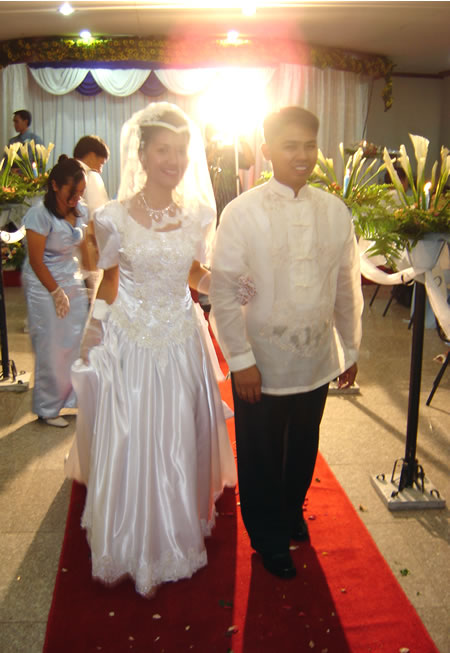

 Some jitters before the big moment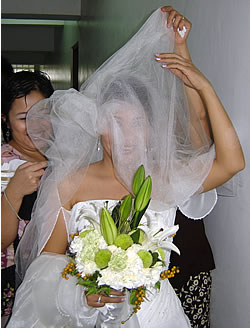


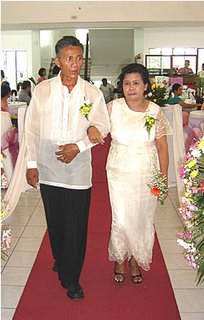 Robert with parents and parents-in-law waiting for the processional


 A picture of serenity
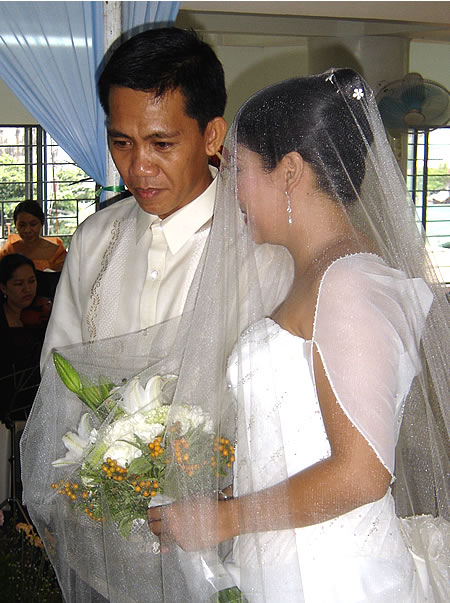 Sharing a secret at the altar
 “Marriage is a covenant between a man and a woman who agree to live together as husband and wife for as long as they both live. We have chosen each other carefully and have received premarital counseling on the nature, purposes and responsibilities of marriage. We understand that a covenant marriage is for life.”
 Early Sunday School, 7:30 to 8:30 AM; Sunday School, 9 to 10 AM; Tagalog Sunday School, 9 to 10 AM; Morning Worship Service, 10 to 11:30 AM; Tagalog Worship Service, 10 to 11:30 AM; Young People’s Fellowship, 3 to 4:45 PM; Men’s Alive Fellowship, 3:45 to 4:45 PM; Moms in Touch Fellowship, 3:45 to 4:45 PM; Evening Worship Service, 5 to 6:30 PM; Wednesday Prayer Meeting, 7:30 to 8:30 PM; Saturday Outreach: 8:30 to 10 AM; Visitation and saturation, 2 to 5 PM
 Church address: 3970 Sociego St. Sta. Mesa, Manila, near V. Mapa LRT Station and opposite SM Centerpoint. Tel. nos. 716-0803, 716-5554; e-mail address: stamesayouthalive_bbc@yahoo.com


 Christian alternative to YouTube with videos, music, prayer wall, devotional Bible reading and chat room
 How can you believe miracles in the Bible? Is the New Testament filled with myths? What about all those contradictions? Was Jesus born of a virgin? The historicity of Jesus; Messianic prophecies fulfilled in Jesus; The resurrection of Jesus; Is Jesus both Messiah and God? Hinduism; Buddhism; Shintoism; Judaism; Islam; Agnosticism, Atheism and Secular Humanism; Jehovah's Witnesses; Mormonism; Astrology; The Authority of the Believer; Questions About God; Questions About Faith and Reason
 Please click the picture to get to the directory. For churches and ministries with websites, please click the links below.


 Amy Perez case: psychological incapacity in declaring a marriage null and void; Adultery, concubinage and psychological violence; Can a mother be deprived of custody of her child? Can an unwed mother avail of the benefits of the Solo Parents Welfare Act? Divorce obtained abroad by a Filipino not recognized here; How to disinherit your spouse; Support for abandoned woman and family; The "Battered Woman Syndrome" as defense; The right of a divorced Filipino spouse to remarry under Article 26 of the Family Code; What happens in an annulment case if the respondent fails to file an Answer? RA 9262 Anti-Violence Against Women and their Children Act of 2004; and other articles
 “Marriage is a covenant between a man and a woman who agree to live together as husband and wife for as long as they both live. We have chosen each other carefully and have received premarital counseling on the nature, purposes and responsibilities of marriage. We understand that a covenant marriage is for life.”